
Are Your Restaurant’s Instagram Reels Bringing Diners? A Mumbai and Navi Mumbai Owner’s Checklist
Your restaurant’s latest Reel looks impressive. The food is beautifully presented, the music fits, and the views are climbing. But has anyone booked a table because of it? For restaurant owners in Mumbai and Navi Mumbai, this question deserves space in every social media review. Views help you understand attention. To assess business value, you […]
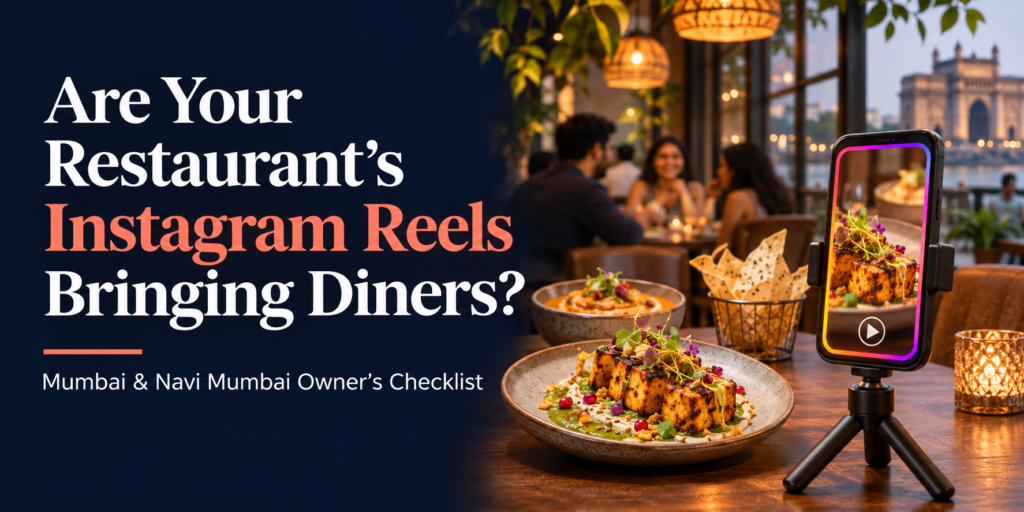
Your restaurant’s latest Reel looks impressive. The food is beautifully presented, the music fits, and the views are climbing.
But has anyone booked a table because of it?
For restaurant owners in Mumbai and Navi Mumbai, this question deserves space in every social media review. Views help you understand attention. To assess business value, you also need to examine enquiries, reservations, completed visits and customer spending.
A Reel can introduce your restaurant today and influence a visit later. The challenge is finding useful evidence without claiming that every booking came from Instagram.
The examples below are illustrative scenarios, not verified client results.
1. Decide What Each Reel Should Achieve
Before filming, choose one main purpose.
A Reel might introduce a new café, explain a lunch offer, showcase private dining or encourage weekend reservations. Each purpose needs a suitable next step and a different way to assess results.
For example, a Vashi restaurant promoting weekday lunch should show the food, explain when lunch is available and tell viewers how to check the menu.
A cinematic video of the interiors may support awareness. It provides less information about whether the lunch offer suits someone’s budget or schedule.
Write the goal in one sentence: “This Reel should help nearby office workers consider us for weekday lunch.”
That sentence gives your team a clearer brief.
2. Make Your Location and Dining Experience Clear
A food video can attract attention from people who are unlikely to visit.
Help viewers quickly understand:
- Where the restaurant is located.
- What kind of food and experience it offers.
- Whether it suits their occasion.
- How to find the menu or ask a question.
“Mumbai” alone may be too broad for someone planning dinner. Mentioning the actual neighbourhood such as Andheri, Powai, Vashi or Kharghar, provides more useful context.
Show details customers genuinely ask about: seating, vegetarian options, accessibility, parking arrangements or family dining. Verify each claim before including it.
Location information helps people assess suitability. It does not guarantee that Instagram will distribute the Reel to nearby customers.
3. Read Instagram Metrics Alongside Business Actions
Instagram’s professional-account insights provide information about content performance and engagement. Available metrics and labels can vary by account and content type. Meta’s insights documentation explains the broader reporting capabilities. developers.facebook.com
Use those figures as one part of your review:
| Signal | What it helps you understand | What it does not prove |
|---|---|---|
| Views | Whether the content attracted viewing activity | That viewers were nearby or visited |
| Saves and shares | Whether people wanted to retain or pass on the content | That a reservation followed |
| Relevant messages | Whether viewers had practical questions | That they completed a visit |
| Confirmed reservations | Whether enquiries progressed | That Instagram alone caused them |
| Completed dining visits | Whether recorded bookings became customers | That every visit was an additional sale |
A comment asking about buffet timing deserves a different response from a fire emoji. Both are interactions; only one clearly expresses a practical dining question.
4. Give Interested Viewers an Easy Next Step
After watching, can someone find your menu, opening hours and booking route without searching through old posts?
Check your profile from a customer’s phone. Open the menu link, test the reservation page and confirm that contact details work.
Choose one relevant call to action for each Reel:
- “View the lunch menu through our profile.”
- “Message us to enquire about group dining.”
- “Check availability before planning your visit.”
Avoid promising instant confirmation when your team must manually approve reservations.
This is where content and profile management need to work together. Vayutech Global Solutions’ social media marketing framework connects profile information, original content, customer communication and enquiry handling rather than treating posting as an isolated task.
5. Record How Enquiries Become Diners
Create a simple booking-source record.
When appropriate, ask: “How did you hear about us?” Let staff record Instagram, Google, recommendation, walk-in or another source without pressuring customers.
For a specific campaign, you could invite viewers to mention a booking keyword. Record whether those enquiries became confirmed reservations and completed visits.
Suppose a Kharghar restaurant receives several messages about birthday dinners. If nobody follows up with availability, menu options and booking conditions, the problem may be enquiry handling rather than the Reel.
Record the customer’s requested date, party size, response status and final outcome. Keep only the information your team needs and handle it responsibly.
6. Use Trackable Links Where They Help
If your restaurant has a website, use campaign-tagged links in appropriate clickable placements, such as a profile link or Story link.
Google’s campaign URL guidance explains how UTM parameters help identify referring campaigns. Use consistent names so reports remain understandable. Analytics Help
Remember the limits. A shared profile link may identify Instagram traffic without identifying the exact Reel that influenced someone. External booking platforms may also restrict measurement.
Report what the data establishes. A website session, booking-button click and completed reservation are separate events.
7. Compare Costs With Completed Visits
Include filming, editing, creator fees, advertising spend and any offer costs when reviewing a campaign.
For an illustrative calculation, suppose a campaign costs ₹12,000 and your records connect it with 20 completed dining parties. That equals ₹600 per recorded party.
This is not proof of profitability or additional sales. You still need to consider party size, spending, food costs, discounts and customers who might have visited anyway.
Also separate organic and paid results. If you use Meta advertising to distribute restaurant content, report advertising spend alongside the enquiries and visits it supports.
A Practical Weekly Review
Ask your team five questions:
- Which Reel generated relevant dining questions?
- Could viewers easily find the menu and location?
- Were enquiries answered and followed through?
- Which recorded reservations became completed visits?
- What single improvement should we test next?
Instagram Reels can help customers discover and evaluate your restaurant. Their value becomes clearer when you connect content with a reliable booking process and honest measurement.
For owners reviewing that journey, Vayutech Global Solutions can help assess content direction, profile clarity and enquiry tracking. Start with one dining objective and a manageable test not a promise of virality